
Blog
PCOS (PMOS) and strength training: what the research shows
What the NHS, the 2023 international guideline, an exercise position statement, reviews and a resistance trial found on exercise and PCOS.
By Susmit Jalan, coach at Online Fitness Worldwide.
An international consensus chose polyendocrine metabolic ovarian syndrome (PMOS) as the new name for polycystic ovary syndrome, with a transition period under way.[4] The NHS lists a higher likelihood of PMOS if a close relative has it or for people from an Asian background.[2] A Cochrane review states that PCOS affects 8% to 13% of reproductive-aged women.[5]
The 2023 international guideline maintains emphasis on healthy lifestyle, emotional wellbeing and quality of life, with awareness and consideration of weight stigma, and states that the evidence remains of generally low to moderate quality.[3]
A meta-analysis of 18 trials found that, compared with control, exercise reduced fasting insulin, HOMA-IR, total and LDL cholesterol and triglycerides (low or very low-quality evidence). Compared with usual care, exercise improved VO2max (3.84 ml/kg/min), waist circumference (−2.62 cm) and body fat percentage (−1.39%). No effect was found for blood pressure, fasting glucose or HDL cholesterol.[6]
A Cochrane review of 15 studies (498 participants) found lifestyle intervention may reduce weight (−1.68 kg) and the free androgen index (low-quality evidence). No studies assessed live birth or miscarriage, or reported menstrual regularity.[5]
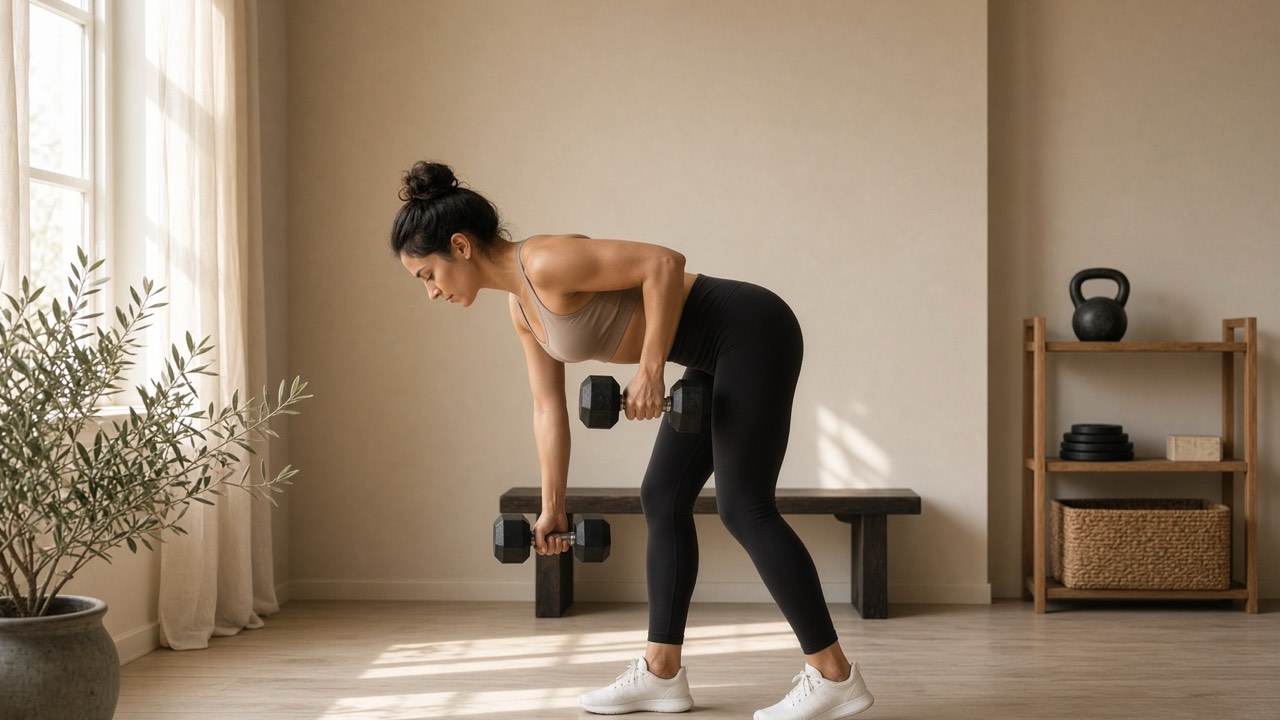
In a study of 45 sedentary women with PCOS (and 52 without), progressive resistance training three times a week for 4 months reduced plasma testosterone, fasting glucose and waist circumference, and increased muscle mass indexes compared with baseline.[8]
See also: Strength training and fat loss: what the research shows · Strength training and type 2 diabetes: what the research shows
Exercises used in the cited studies and guidelines
Progressive resistance training
- In the sources
- Performed three times a week for 4 months in the PCOS study.[8]
Exercise, or exercise and diet
- In the sources
- Compared with control and usual care in the 18-trial meta-analysis.[6]
Muscle-strengthening activities on two non-consecutive days
- In the sources
- Part of the 2024 PCOS exercise position statement.[7]
Doses and protocols the studies used
The 2024 position statement gives targets for individuals with PCOS of 150 to 300 minutes of moderate or 75 to 150 minutes of vigorous aerobic activity a week, plus muscle-strengthening on two non-consecutive days; for further benefits and modest weight loss, at least 250 minutes moderate or 150 minutes vigorous, plus the two strength days.[7]
The same statement states that exercise professionals should consider the psychological burden, including weight stigma, and the high prevalence of comorbidities.[7]
WHO's 2020 guidelines state that adults should do 150 to 300 minutes of moderate aerobic activity (or 75 to 150 minutes vigorous) a week, and muscle-strengthening activities involving all major muscle groups on 2 or more days a week.[1]
About OnlineFitnessWorldwide
OnlineFitnessWorldwide runs live 1:1 and small-group strength and conditioning coaching online by video call (Google Meet, Zoom or FaceTime). Session times are agreed when you book.
Programs: Iron Hour, 60 minutes, 1:1. Lean Reset, 20 sessions a month, 1:1. Return, 45 minutes, 12 alternate-day sessions a month. Open Floor, small group. The Consultation is 30 minutes and is not a training session. A booking holds a time; the fee is agreed directly.
The coach is not a doctor or physiotherapist.
What the guidelines and sources state on safety
The NHS states to see a GP if someone thinks they might have PMOS or the symptoms are affecting everyday life, work and relationships.[2] The resistance training study compared results with baseline.[8]
ACSM's 2015 screening model bases pre-exercise medical clearance on current activity, signs or symptoms and/or known cardiovascular, metabolic or renal disease, and desired intensity.[10]
This page reports what the cited sources found and state. It gives no advice and recommends no course of action. It is not medical advice.
ASCA Level 1 (strength and conditioning) and ACE (anatomy and biomechanics). These are credentials held by the coach. Neither body endorses this business or this article.
Sources
- [1] World Health Organization. WHO guidelines on physical activity and sedentary behaviour. Geneva: WHO; 2020. https://www.who.int/publications/i/item/9789240015128 (opens in a new tab)
- [2] NHS. Polyendocrine metabolic ovarian syndrome (PMOS), previously called polycystic ovary syndrome (PCOS). nhs.uk. Reviewed 30 June 2026. https://www.nhs.uk/conditions/polyendocrine-metabolic-ovarian-syndrome-pmos/ (opens in a new tab)
- [3] Teede HJ, Tay CT, Laven J, et al. Recommendations from the 2023 International Evidence-based Guideline for the Assessment and Management of Polycystic Ovary Syndrome. Fertil Steril. 2023;120(4):767–793. https://doi.org/10.1016/j.fertnstert.2023.07.025 (opens in a new tab)
- [4] Teede HJ, Khomami MB, Morman R, et al. Polyendocrine metabolic ovarian syndrome, the new name for polycystic ovary syndrome: a multistep global consensus process. Lancet. 2026;407(10545):2329–2339. https://doi.org/10.1016/S0140-6736(26)00717-8 (opens in a new tab)
- [5] Lim SS, Hutchison SK, Van Ryswyk E, Norman RJ, Teede HJ, Moran LJ. Lifestyle changes in women with polycystic ovary syndrome. Cochrane Database Syst Rev. 2019;3(3):CD007506. https://doi.org/10.1002/14651858.CD007506.pub4 (opens in a new tab)
- [6] Kite C, Lahart IM, Afzal I, et al. Exercise, or exercise and diet for the management of polycystic ovary syndrome: a systematic review and meta-analysis. Syst Rev. 2019;8(1):51. https://doi.org/10.1186/s13643-019-0962-3 (opens in a new tab)
- [7] Sabag A, Patten RK, Moreno-Asso A, et al. Exercise in the management of polycystic ovary syndrome: a position statement from Exercise and Sports Science Australia. J Sci Med Sport. 2024;27(10):668–677. https://doi.org/10.1016/j.jsams.2024.05.015 (opens in a new tab)
- [8] Kogure GS, Miranda-Furtado CL, Silva RC, et al. Resistance exercise impacts lean muscle mass in women with polycystic ovary syndrome. Med Sci Sports Exerc. 2016;48(4):589–598. https://doi.org/10.1249/MSS.0000000000000822 (opens in a new tab)
- [9] American College of Sports Medicine. Position stand: Progression models in resistance training for healthy adults. Med Sci Sports Exerc. 2009;41(3):687–708. https://doi.org/10.1249/MSS.0b013e3181915670 (opens in a new tab)
- [10] Riebe D, Franklin BA, Thompson PD, et al. Updating ACSM's recommendations for exercise preparticipation health screening. Med Sci Sports Exerc. 2015;47(11):2473–2479. https://doi.org/10.1249/MSS.0000000000000664 (opens in a new tab)